Blue Gum Forest - Conservation Countdown
50,000 years of Aboriginal management of country.
1804 Explorer and botanist observes smoke in the valley while on Mount Banks, and attributes it Aboriginal activity.
1859 A series of the first wilderness landscape photographs, almost certainly the first in Australia, taken of the Grose Gorge by Robert Hunt.
1875 7 December: The Grose and Govetts Gorges and surrounding plateau areas are reserved from further sale to protect potential water supply resources.
1931 The ‘save Blue Gum Forest’ campaign is ignited by the intentions of C. Hungerford, a lease holder on the Grose River and Govetts Creek junction, to clear the stand of tall Blue Gums.
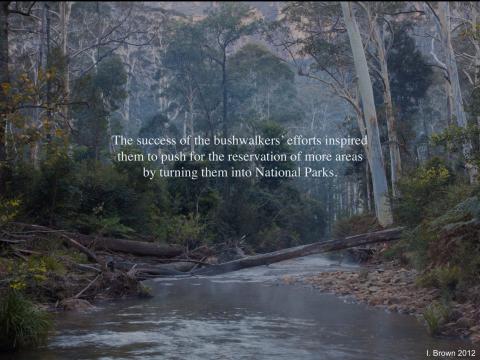
1932 The Blue Gum Forest Committee, consisting of the Wildlife Preservation Society, the Sydney Bush Walkers and the Mountain Trails Club, paid Hungerford 130 pounds to relinquish the lease, with the aid of a personal loan from the then Commissioner of Railways, W.J. Cleary. The land was thus returned to the Crown and, thanks to lobbying by the Committee, was proclaimed a Recreation Reserve on 2 September 1932.
The Blue Gum campaign is a catalyst for the formation of the Federation of Bushwalking Clubs as well as the National Parks and Primitive Areas Council, Australia’s first wilderness society, headed up by Myles J. Dunphy.
1933 The Grose Valley proclaimed a ‘district’ under the Birds and Animals Protection Act following the recommendation by W.J. Baltzer that the area becomes a wildlife sanctuary.
1934 August: The National Parks and Primitive Areas Council’s proposal for a Greater Blue Mountains National Park is published as a supplement to the Katoomba Daily.
1945 The Popes Glen Reserves was established on land donated for the reserve along an 1890s walking track beside the creek and extended on land acquired by Blue Mountains City Council since 1965 for that purpose.
1959 25 September: The Blue Mountains National Park is proclaimed, covering much of the Grose catchment. The Blue Gum Forest reserve is incorporated into the park two years later and the remaining private inholdings in the Grose Valley acquired 10 years later.
1960 Milo Dunphy’s architectural firm takes on the task of developing a tourist complex at Govetts Leap, and by a series of proposed modifications including a lift to the valley floor, skating ring, faces of explorers carved into cliff faces, miniature railway, a heliport, “Pioneer Village”, Cobb and Co coach rides saved the site by delay.
1966 March: The Federation of Bushwalking Clubs propose wilderness zonings over the Grose Canyon/Kolonga area and the Carmarthen Labyrinth. The proposal gained the support of the Park Trust but was not implemented before the Trust was superseded in 1972 by the NSW National Parks and Wildlife Service (NPWS).
1970 The NPWS places a temporary ban on camping in the Blue Gum Forest, with alternative sites provided at Acacia Flat. The ban became permanent in 1977, with the support of the Federation of Bushwalking Clubs, National Parks Association and Boy Scouts Association.
1980 The Sydney Water Board assume responsibility for Upper Blue Mountains sewage systems.
1987 8 May: Blue Mountains Sewage Management Strategy is released proposing expenditure of $125 million over 20 years to upgrade and replace sewage treatment facilities in the Blue Mountains. The first step of the strategy is a sewage tunnel from Winmalee to North Springwood and the decommissioning the Valley Heights, Springwood and North Springwood plants, diverting the effluent to the new Winmalee plant.
1988 January: NPWS produces Draft Plan of Management for Blue Mountains National Park, but is shelved after public exhibition.
1988 4 May: A 29 kilometre, $83 million dollar sewage tunnel from Faulconbridge to North Katoomba announced by Environment Minister, Tim Moore. It is essentially Stage Two of the Sewage Management Strategy as the tunnel is already constructed to North Springwood. The proposal would divert effluent from five old treatment plants to the modern Winmalee plant. The proposal is approved in 1990 and an extension to Mount Victoria, Blackheath and Medlow Bath is foreshadowed subject to further study.
1989 Colong Foundation publish ‘Blue Mountains for World Heritage’ - a proposal covering 897,661 ha of the Greater Blue Mountains. The author, Geoff Mosley, notes that the Grose meets all the criteria for wilderness.
1989 Popes Glen Bush Care established to manage runoff and weed infestation management along the urban interface and has successfully restored native upland swamp and riparian vegetation by scientific methods.
1991 The Blue Mountains Local Environmental Plan is adopted, seeking to preserve from urban sprawl the natural features of the Mountains.
1992 Following the 60th anniversary of the saving of the forest, the community group Friends of Blue Gum was formed, facilitated by ranger Cath Ireland. Members of this group have continued to promote the significance of the saving of the forest, and organised major anniversary events in collaboration with NPWS. The group also initiated a historical research project, which resulted in publication of a number oral history interviews, and (in 1997) the publication of the ‘Back from the Brink’ book.
1994 Friends of Blue Gum Forest (the NPWS, the Blue Mountains City Council and local Bushcare volunteer groups) hold the first annual ‘Great Grose Gorse Walk’ along the river, aimed at controlling the weeds Gorse and broom in the catchment.
A preliminary assessment of the Colong Foundation’s 1989 Blue Mountains for World Heritage proposal by the National Herbarium identifies most of the Sydney Basin sandstone National Parks, and adjoining areas, as suitable for inclusion in a nomination boundary.
1996 January: The Confederation of Bushwalking Clubs NSW submits a nomination under section 7 of the Wilderness Act 1987 for the Grose Wilderness.
July: Sewage tunnel to North Katoomba is commissioned. Subsequently the North Katoomba and Wentworth Falls sewage treatment plants are decommissioned and the affected areas are rehabilitated by September 1999.
1998 January: A new Draft Plan of Management for Blue Mountains National Park is exhibited. The plan proposes to allow vehicle use by permit of the Grose Road to Faulconbridge Point which was locked following bushfires in January 1994.
June: The State and Federal Governments lodge a nomination to IUCN for World Heritage listing of the greater Blue Mountains. The nomination covers Blue Mountains, Gardens of Stone, Kanangra-Boyd, Nattai, Thirlmere Lakes, Wollemi and Yengo National Parks.
June: Sydney Water release a sewage overflows EIS which aims to reduce the discharge of raw sewage during wet weather.
1999 January: Three years after the Wilderness nomination, the Director General of NPWS has not formally identified the Grose in accordance with the requirements of the Wilderness Act 1987.
26th February: The Government gazettes 900 ha of Crown Land at the head of the Grose Valley as part of Blue Mountains National Park. This area was removed from the park in 1967 to allow the Grose Colliery to mine for coal. The area was in 1998 part of a $20 plan to fence in the Grose Wilderness for an Earth Sanctuary.
March: The Grose Wilderness Assessment is released and exhibited for a 3 month period for public submissions. Also in March, the Government commits to fund the Blue Mountains Run-off Control Program for one million dollars a year over four years.
2000 November 29: The Greater Blue Mountains was inscribed on the World Heritage list for its eucalypt forest diversity and as a living laboratory of natural biodiversity, including its ancient plants as exemplified by the Wollemi Pine.
2001 May 12: Celebration and dedication ceremony at Govetts Leap, site of numerous tourism development proposals.
Also in 2001, the Blue Mountains National Park plan of management was adopted, the 38,000ha Grose Wilderness is declared and the Blue Mountains local environmental plan improved to better protect the environmentally sensitive urban fringe vulnerable to fire and not connected to sewerage.
2004 The Blue Mountains Conservation Society successfully protect the Grose Wilderness in the Land and Environment Court from a proposed war movie and by doing so set a legal precedent protecting wilderness from commercial leases using a tactical combination of creative peaceful protest and determined professional effort.
2006 Upper Blue Mountains Sewerage Scheme connecting Mount Victoria, Blackheath, and Medlow Bath to the Sewerage Tunnel is approved.
2015 Mountains World Heritage Area Advisory Committee publish Values for a new generation: Greater Blue Mountains World Heritage Area proposing further consideration of geodiversity, scenery, including wilderness, and cultural values. These additional values apply to the Grose Wilderness and Blue Gum Forest.
2018 Chalet-style commercial accommodation proposed by The Stafford Group at Govetts Leap in the Blue Mountains Destination Management Plan is rejected by Blue Mountains City Council following strong community opposition.
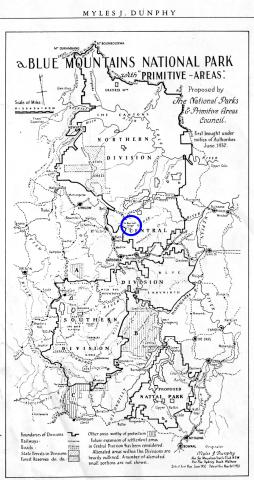
The bushwalker who pushed hardest for the national parks was Myles Dunphy.
His original vision for a huge Blue Mountains national park eventually came to pass
in the form of the Greater Blue Mountains
World Heritage Area, which contains seven national parks and embraces a million hectares.